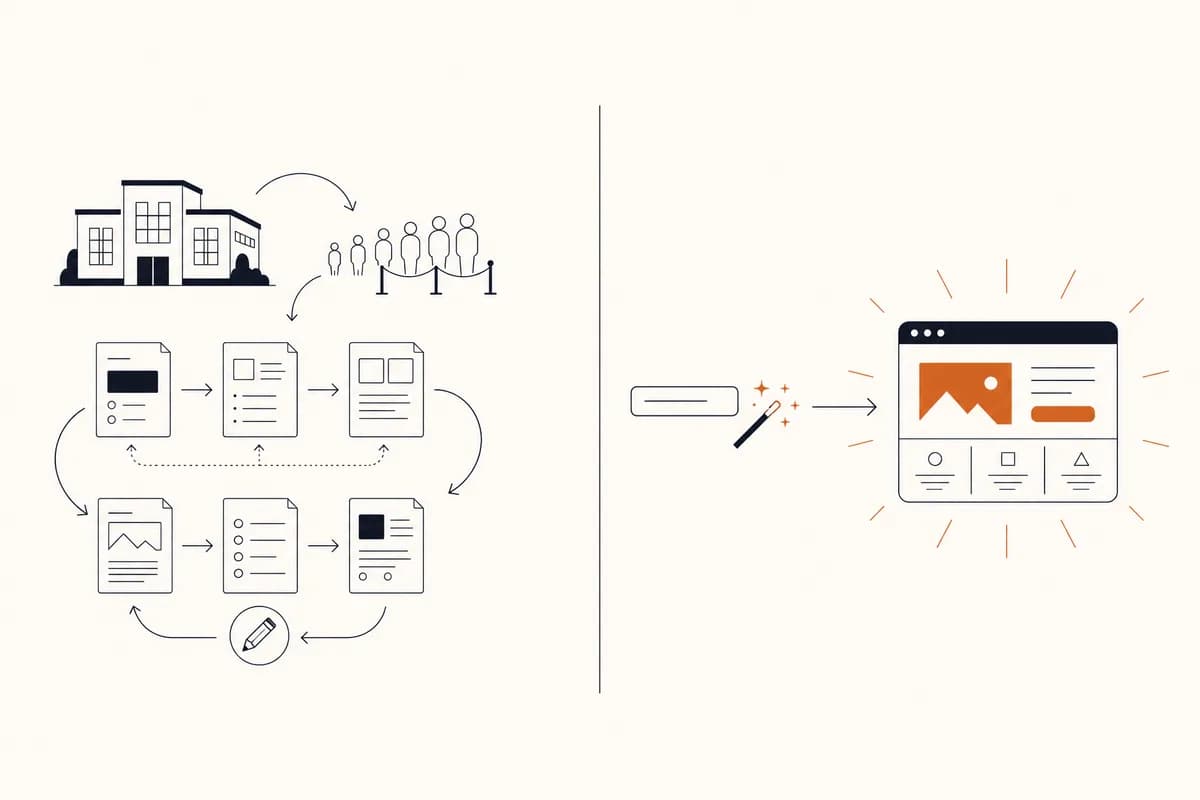
You can build a website yourself with AI in an afternoon, or you can hand the whole thing to a designer and wait a few weeks. Both can produce a site you're proud of. The honest answer to which one you should pick is: it depends on your budget, your timeline, how custom you need it to be, and whether you want to make changes yourself later. If the category itself is new to you, our guide to AI website builders explains how they work.
Here's the short version. If you need a clean site live soon, want full control, and your budget is tight, an AI website builder is usually the right call. If you need something genuinely custom, complex, or you'd rather not touch it at all, a web designer earns their fee. Most small businesses fall into the first camp. Plenty don't. Let's walk through how to tell which one is you.
The quick comparison
Before the details, here's the picture at a glance.
| Factor | AI website builder | Web designer |
|---|---|---|
| Upfront cost | Low monthly subscription | A few hundred to several thousand dollars |
| Time to launch | Hours to a couple of days | Two to eight weeks, sometimes longer |
| Custom design | Good, within sensible limits | Fully custom |
| Who makes changes | You, by prompt or editor | The designer, usually for a fee |
| Best for | Speed, budget, control | Distinctive brands, complex builds |
| Ongoing edits | Included, instant | Billed per change or retainer |
Neither column is "the winner." They solve different problems. Read on and the right fit usually becomes obvious.
What an AI website builder actually does
An AI website builder takes a short description of your business and generates a full website. You type what you do, who you serve, and what you want visitors to do. It writes the copy, lays out the pages, picks the design, and gives you something live. Then you refine it.
The big shift is editing. With a tool like Forgelo, you change any section by describing what you want. "Make the headline shorter." "Add a pricing section with three plans." "Move the contact form higher." No code, no design software, no waiting on someone else's calendar. If you want to see the full flow, our how it works page breaks it down step by step.
Cost is the obvious draw. AI builders run on a subscription, usually a modest monthly fee, and that fee typically covers hosting, updates, and unlimited edits. You can check our pricing to see real numbers. Speed is the other draw. Most people get a basic site live the same day they start.
What you give up is unlimited freedom. AI builders work from patterns that already convert. That's a feature for most businesses and a limitation for a few. If your brand depends on a look nobody has seen before, a builder will get you close but maybe not all the way.

What a web designer actually does
A good web designer does more than make things pretty. They ask about your customers, your goals, and your competition. They make judgment calls you might not think to make. They build a site that fits your business specifically, not a business like yours.
That judgment is the real value. A designer can spot that your offer is confusing, that your pricing scares people off, or that your strongest selling point is buried on page three. AI is getting better at this, but an experienced human still reads context in a way software doesn't always match.
The trade-offs are cost and time. Freelance web designers commonly charge anywhere from a few hundred dollars for a simple site to several thousand for something larger. Agencies charge more, sometimes a lot more, because you're paying for a team. Timelines usually run a few weeks once you count discovery, drafts, revisions, and the back-and-forth.
Then there's the part people forget: changes. After launch, every tweak usually means emailing the designer and waiting, often with a bill attached. Some work on retainers, which smooths this out but adds a recurring cost. If you like updating your site often, factor this in. We dig into the full math in our guide on how much a website costs.
Cost: where the money really goes
People compare the sticker price and stop there. Don't. Look at the total over a year or two.
With an AI builder, the cost is predictable. You pay your subscription, you make all the edits you want, and that's mostly it. No surprise invoices when you need a new page in March.
With a designer, the upfront fee is only the start. Add hosting if it isn't included, add a maintenance plan or per-change fees, and add the cost of your time spent briefing and reviewing. None of that is hidden or unfair. It's just real, and it adds up. A site that cost two thousand dollars to build can quietly cost more again over its life.
Here's a fair way to think about it. If your budget is tight and you want certainty, the builder wins on cost almost every time. If you've got the budget and you value a custom result more than the savings, the designer's price can be money well spent.
Speed: how fast do you need to be live?
This one's simple. AI builders are faster. Much faster.
If you launched a business yesterday and need a site by Friday, you're not really choosing. A designer's calendar alone can push your launch out weeks. With an AI builder you can describe your business, generate a site, and have it live before lunch. You can learn how to build a website with AI in our step-by-step walkthrough.
Speed isn't only about launch day, though. It's about every change after. Need to update your hours, add a new service, or run a promotion? With a builder you do it in minutes. With a designer you wait. For some people that wait is fine. For others it's the whole reason they switch.
Quality and control: the honest middle ground
This is where the comparison stops being one-sided.
A skilled designer can produce work that's genuinely better than what most builders generate, especially for brands that need to stand apart. If your business lives or dies on visual identity, say a creative studio or a premium product, a human's taste matters. AI builders produce good, professional sites. "Distinctive" is a higher bar.
Control runs the other way. With an AI builder, you own the keys. You change anything, anytime, without asking permission or paying per edit. With a designer, you're handing the wheel to someone else. Many people prefer that. They'd rather not learn the tools and would happily pay to never touch the site. That's a legitimate choice, not a weakness.
So ask yourself: do you want a site you control, or a site someone else maintains for you? There's no wrong answer. There's only the one that fits how you like to work.
When a designer genuinely wins
To be fair to designers, here's where hiring one is the smart move:
- You need a custom brand identity that can't look like a template.
- Your site needs complex features: a custom booking system, a membership area, deep integrations.
- You have a large site with hundreds of pages and real information architecture work.
- You simply don't want to be involved and prefer to delegate it entirely.
- You're an established business where the website is a major revenue channel and worth a serious investment.
In these cases, paying for expertise pays off. Don't try to force an AI builder to do a job it isn't built for. You'll spend more time fighting it than you'd save.
When an AI builder genuinely wins
And here's where the builder is the better pick:
- You're a small business, freelancer, or solopreneur on a budget.
- You need to launch quickly and start getting customers.
- You expect to update the site often and want to do it yourself.
- Your needs are standard: clear pages, a way to get found, a way to capture leads.
- You're testing an idea and don't want to spend big before you know it works.
Most new and small businesses live here. A fast, clean site that explains your offer and routes leads to your phone is enough to win real work. With Forgelo, lead forms route straight to your WhatsApp, so inquiries land where you already reply. Browse the templates to see what a finished site can look like.
You can do both
This isn't a one-time, permanent decision, and treating it that way is a trap.
A common path: start with an AI builder, launch this week, and get your first customers. Once you know what's working, what people actually click, and where the money comes from, then decide if a custom designer is worth it. By that point you'll brief them far better because you'll have real data, not guesses.
Starting cheap and fast doesn't lock you out of anything. It just buys you time and information before you spend big. For a lot of people, the AI site ends up being plenty, and the designer money goes toward things that grow the business faster.
If you're weighing builders specifically, our Forgelo vs Wix comparison breaks down how different tools handle the same job.
The takeaway
Pick the AI website builder if you want speed, a tight budget, full control, and a site that does the standard job well. Pick a web designer if you need something custom, complex, or you'd simply rather hand it off and never touch it. Most small businesses are better served by a builder, at least to start, and that's not a knock on designers. It's a match of tool to need.
The worst choice is no choice. A live, decent site beats a perfect one that's still in someone's inbox. Start where you are, launch something real, and upgrade when the business tells you to. If you are now weighing AI builders against each other rather than against a designer, see how Forgelo compares.