An AI website from one sentence sounds like a party trick until you look at what the system actually has to decide. You type something like "a physiotherapy clinic in Leeds for runners recovering from knee injuries" and a complete page comes back: navigation, a hero, a services block, proof, an FAQ, a contact section. Every one of those blocks, and every color, font and headline inside them, had to be decided from about a dozen words. This article is about that gap, which parts of it AI closes well, and which parts it structurally cannot close no matter how good the model gets.
TL;DR. One sentence carries enough signal for a system to infer your business category, your audience, a plausible tone, and a sensible set of sections. It carries almost no signal about facts: your prices, your hours, your real credentials, the thing that actually makes you different. So the first draft is right about shape and wrong about specifics. The practical fix is not a longer prompt, it is editing one section at a time after the draft exists.
If you want the step-by-step pipeline view, we covered that in how AI generates a website. If you want the category defined, including how it differs from templates, that is what is prompt-to-website, and the wider tool landscape is in our guide to the AI website builder. This piece stays on the input side: what a single sentence is actually worth, and what it is not.
What actually happens when you hand AI one sentence?
The important thing to understand is that the model is not writing a web page. It is filling in a document.
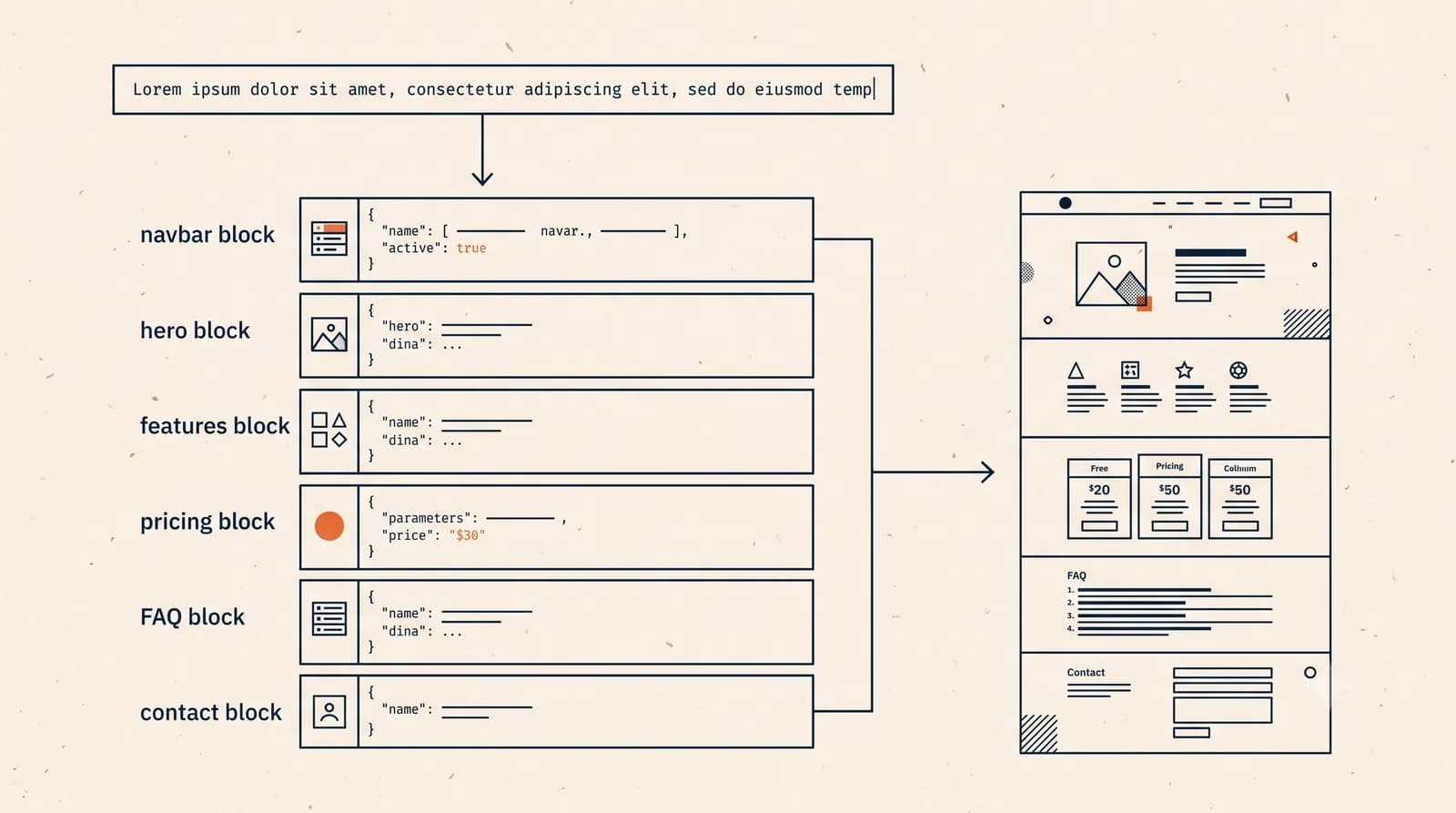
Inside Forgelo, a website is a JSON document. It has a version, a small metadata block (page title, meta description, language), a theme object, and an ordered array of sections. Each section is a node shaped like { id, type, props }. The renderer takes that document and produces HTML. The document is the source of truth; the HTML is just the output.
That distinction matters more than it sounds. Because the site is data rather than a blob of markup, the generation step is a constrained problem: produce a document that satisfies a schema. This is the same technique the industry calls structured output. OpenAI's structured outputs guide describes it plainly as making sure the model "will always generate responses that adhere to your supplied JSON Schema," and notes that the JavaScript SDK defines those schemas with Zod, a TypeScript-first validation library. Forgelo validates generated documents against a Zod schema for exactly that reason.
So the real question is not "can AI write a website." It is "can a sentence supply enough information to fill a schema with fifteen possible section types and a fully specified theme." The honest answer is: partly.
How many decisions does one sentence have to cover?
Let us be concrete, because vague claims about AI complexity are useless.
The section library has fifteen types: navbar, hero, features, pricing, faq, cta, footer, testimonials, stats, gallery, about, process, logos, contact, and map. The generator has to decide which of those appear, how many, and in what order. Include pricing or leave it out? Does a solo physiotherapist need a stats bar? Does a map belong above or below the contact form? Those are editorial calls, and there is no single correct answer.
Then there is the theme, which is not a vibe but a set of named values. Light or dark mode. Eight palette colors (background, surface, text, muted, border, brand, brand text, accent). Two font choices, one for headings and one for body. Corner radius from sharp, soft, or round. Layout density from compact, cozy, or spacious. Button style from solid, outline, or pill. That is fourteen theme decisions before a single word of copy exists.
Add the metadata block, three more decisions. Then the props inside every section: headlines, subheadings, button labels, service names, service descriptions, FAQ questions and their answers, alt text for every image.
Your sentence has maybe twelve to twenty words in it. The output has dozens of filled slots. The model is not retrieving your website, it is reconstructing the most probable one for a business that sounds like yours. Understanding that reframes the whole exercise: you are not commissioning a site, you are seeding a reconstruction.
What AI infers well from a single sentence
Some of that reconstruction is genuinely reliable, and it is worth knowing which parts, so you stop double-checking the things that are usually fine.
Category and structure. "Physiotherapy clinic" is a strong signal. Clinics need a services block, credentials, a booking path, and location. That inference is not clever, it is just very well evidenced. Models have seen an enormous number of clinic sites, and clinic sites really do look alike for good reasons.
Audience. "For runners recovering from knee injuries" narrows tone, imagery, and which services lead. The resulting page will talk about return-to-sport timelines rather than general wellness. That is the single highest-leverage clause you can include.
Tone. Adjectives do real work. "Calm," "premium," "no-nonsense," and "playful" each move the palette, the density, and the sentence rhythm of the copy. If you say nothing about tone, you get the safe middle, which reads as slightly corporate.
Copy scaffolding. Headline length, the shape of a benefit list, where a call to action belongs, how long an about paragraph should be. This is craft the model has absorbed at scale, and it is consistently better than a first-time site owner staring at an empty box.
Technical assembly. Responsive behavior, heading hierarchy, alt text on images, a valid meta title and description. These used to be the tedious part. Now they are the part you barely think about.
What one sentence can never tell it
Here is the section that matters most, and the one most AI website builder marketing skips.
A sentence cannot carry facts it does not contain. That sounds obvious written down, but it is the source of nearly every problem with a generated first draft, because the model does not leave gaps blank. It fills them with the most plausible thing, confidently.
Things one sentence structurally cannot supply:
- Your actual prices. If a pricing section appears, the numbers in it are invented. Every single time.
- Your real hours, address, and phone number. Placeholders that look like real data are more dangerous than obvious blanks, because they survive a quick skim.
- Credentials and proof. "Over 15 years of experience" and "award-winning" appear constantly in generated copy. If you did not say it, it is not true, and publishing it is a genuine problem in regulated fields like health, finance, and law.
- Your actual differentiator. Your clinic might be the only one in the city with an anti-gravity treadmill. The model has no way to know, so it writes generic reassurance instead.
- Testimonials. If a testimonials block generates with names attached, those people do not exist. Replace or remove them before publishing.
- Your real photos. Placeholder imagery makes the page feel finished, which is useful for judging layout and actively harmful if you forget to swap it.
None of this is a flaw in the approach. It is arithmetic. Twelve words cannot encode facts that were never in the twelve words. The correct response is not disappointment, it is a review pass. Read the draft as an editor reading a competent stranger's first attempt: the structure is sound, every specific claim is unverified.
This also settles the SEO question people ask nervously. Google's own position, published on Google Search Central, is that it focuses on rewarding high-quality content regardless of whether it is human or AI-generated, while using AI to manipulate rankings violates its spam policies. Generation is not the risk. Publishing unverified claims is. If you want the practical checklist, our website SEO basics guide covers the fundamentals.
How fast is prompt to published, really?
Speed is the reason anyone tries this, so it deserves a straight answer rather than a marketing number.
Writing the sentence takes seconds. Generation does not. It runs in the background and typically lands in a few minutes. You can then publish to a live subdomain the same day, on a free plan, before you have decided on a domain or paid anything.
We are deliberately not claiming a website in literal seconds. Demos that show it are usually rendering a pre-built template or streaming a partial page. The useful comparison is not against an imaginary instant, it is against the alternatives: a week of template shopping, or three to six weeks waiting on an agency round trip. Against those, minutes is the interesting number, and it is a number we can stand behind.
The more important speed measurement is the second one. How long does it take to change something after the site is live? That is where the one-sentence workflow either becomes practical or falls apart.
Why editing one section beats writing a better sentence
The intuitive fix for a wrong first draft is to write a better sentence and run it again. It is also the wrong fix, and understanding why is the most useful idea in this article.
Regenerating from a new prompt reproduces the entire document. Everything changes: the sections that were wrong, and also the headline you liked, the service descriptions that were nearly right, the palette you had settled on. You trade one set of problems for a fresh set. Anyone who has tried to fix a generated page by rewording the prompt five times knows the loop, and it does not converge.
Because the site is a document of independent section nodes, there is a better move. You describe the change to one section, the system produces a replacement node for that section only, and the rest of the document is untouched. "Make the hero headline shorter and mention knee rehab." "Drop the pricing section." "Rewrite the about paragraph in first person." One node out, one node in, re-render.
That is the difference between a generator and a tool. A generator hands you output. A tool lets you converge on what you meant. We go deeper on the mechanics in edit a website by prompt, and you can see the section controls on the features page.
Practically, this changes how you should approach the first sentence. Stop trying to write the perfect prompt. It is a starting position, not a specification. Get a draft on screen, then steer it.
Writing a first sentence that lands closer
You cannot make one sentence carry facts, but you can make it carry the four signals that do the most structural work. Include what the business does, who it is for, the tone, and the one action a visitor should take.
A weak sentence:
Make a website for my physio clinic.
A sentence that lands much closer:
A calm, clinical website for a physiotherapy clinic in Leeds that helps runners recover from knee injuries, with the goal of getting them to book an assessment.
Same length, roughly. The second one specifies category, location, audience, tone, and conversion goal, which means the generator is guessing on far fewer axes.
Here is what typically comes back from that second sentence. A navbar with services, about, and a booking link. A hero leading on return-to-running rather than generic wellness. A services block with three to four entries, probably assessment, rehab programming, and gait analysis. An about section with an invented practitioner backstory. A process section walking through assessment to discharge. An FAQ answering session length, cost, and referral questions. A contact section with a booking call to action. Calm palette, generous spacing, restrained type.
Then the three edits that actually make it yours, which take a few minutes each. Replace the invented credentials with real ones. Correct the services list, because gait analysis may be something you do not offer. Swap the stock clinic photography for pictures of your actual room and equipment.
That is the honest shape of the workflow. Not "type a sentence, get a website." More like "type a sentence, get a complete and slightly wrong website, spend twenty minutes making it true." For a small business site, that is a very good trade. If you want to see the section patterns different business types tend to get, the templates gallery is the fastest way to build intuition, and how it works walks through the full loop. Plans and quotas are on the pricing page, and if the technical side is what has been stopping you, make a website without coding is the better starting point.
The bottom line
One sentence is a real input, not a gimmick. It is enough to determine what kind of site you need, which sections belong on it, how it should feel, and roughly what it should say. That is genuinely most of the work, and it used to take days.
What it is not is enough to make the site true. Every specific number, claim, credential, and photo in the first draft is a plausible guess that needs your confirmation. Builders that skip this part are selling you a demo. Builders that admit it are describing the actual job.
So write the sentence. Include the audience and the goal, because those two clauses do more than any other. Read the result like an editor rather than a customer. Then fix it one section at a time instead of starting over, because the second pass is where a generated page turns into your website.